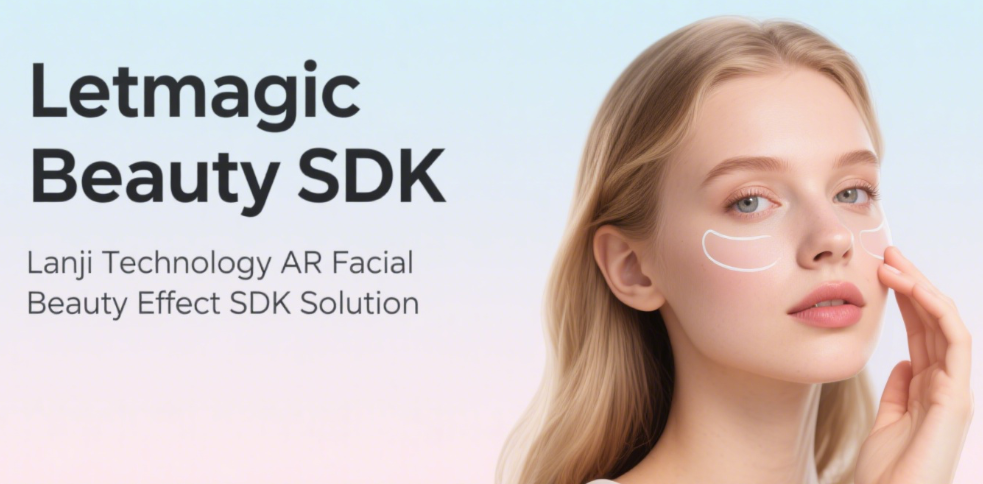
With the rapid development of the mobile Internet and intelligent hardware, AR technology has been deeply integrated into diverse scenarios such as social entertainment, online education, and live-streaming e-commerce. Among these, facial beauty effects— as a core function to enhance users’ visual experience— have become a standard requirement for various application products. Based on years of accumulation in computer vision and graphics rendering technology, Lanji Technology has launched a high-performance, low-power AR Facial Beauty Effect SDK. Through full-link technical optimization, it provides developers with a stable and reliable solution, helping application products achieve an upgrade in visual experience.
Letmagic Beauty Technology’s AR Facial Beauty Effect SDK adopts a layered architecture design, forming a complete technical closed loop from underlying algorithms to upper-layer interfaces.
Algorithm Layer: Relying on the self-developed facial key point detection model, the SDK can achieve high-precision real-time positioning of 106 key points. It performs regional feature extraction for different facial areas (such as the eye area, facial contour, and lip shape) with sub-pixel-level positioning accuracy, laying a foundation for the natural presentation of beauty effects. Meanwhile, through lightweight neural network optimization, the model size is compressed to 60% of that of traditional solutions, and it can still maintain an operating frame rate of over 30fps on mid-range devices, balancing detection accuracy and computational efficiency.
Rendering Engine: The SDK integrates a self-developed real-time graphics rendering pipeline, supporting physically based lighting simulation and material representation. Based on PBR (Physically Based Rendering) technology, beauty effects no longer rely on simple superposition of skin-smoothing filters. Instead, by simulating physical properties such as skin transmittance, pore details, and oil reflection, it achieves a "high-definition without blurriness" natural beauty effect. For different hardware platforms, the SDK has a built-in GPU shader optimization module, which can automatically adapt to graphics interfaces such as OpenGL ES and Metal, reducing the development cost of device compatibility.
Breaking through the traditional "one-size-fits-all" beauty model, the SDK supports intelligent parameter adjustment based on users’ gender, skin tone, and facial features. For example, for male users, it retains the angularity of facial contours and enhances three-dimensional lighting; for female users, it optimizes skin tone uniformity while preserving natural skin texture. It also provides multi-level beauty intensity control, ranging from "natural nude look" to "polished on-camera look," to meet the needs of different scenarios and avoid the "distortion" caused by excessive beauty enhancement.
It integrates effect modules such as dynamic stickers, AR makeup, and 3D virtual props, supporting facial expression-driven interactions (e.g., triggering effect animations via blinking or opening the mouth). Through key point tracking and skeleton binding technology, virtual props can fit naturally with facial movements, solving the problems of "drifting" and "exposure" of traditional stickers. In addition, the SDK provides a background management system for effect materials, allowing developers to independently upload and update effect resources for rapid iteration.
For complex environments such as low light and backlight, the SDK has a built-in AI video quality enhancement algorithm. Through technologies such as dynamic range expansion, noise suppression, and color correction, it improves the clarity and color reproduction of video images. During the beauty processing, it simultaneously optimizes edge sharpening to avoid "blurred separation" between the face and the background, ensuring uniform texture of the overall image.
To facilitate rapid integration by developers, Lanji Technology’s AR Facial Beauty Effect SDK provides a full-platform adaptation solution. It supports native development for Android and iOS, and is also compatible with game engines such as Unity and Unreal, as well as cross-platform frameworks such as React Native and Flutter.
The SDK adopts a modular design, allowing developers to integrate functional modules such as beauty enhancement, effects, and video quality enhancement on demand, reducing the occupation of app package size.
The supporting development toolchain includes:
- Visual Debugging Tool: Real-time preview of the effect of beauty parameter adjustments, supporting parameter saving and export;
- Performance Monitoring Panel: Displays CPU/GPU usage and frame rate data to assist in optimizing performance bottlenecks;
- Detailed Development Documentation: Includes interface descriptions, integrated sample code, and solutions to common problems. The technical team provides 24/7 online support.
Currently, Lanji Technology’s AR Facial Beauty Effect SDK has been widely applied in fields such as short-video social networking, online live streaming, video conferences, and intelligent hardware.
- In live-streaming e-commerce scenarios, it helps streamers achieve a natural on-camera effect and improve users’ viewing experience;
- In online education scenarios, it combines virtual avatars with real-time beauty enhancement to enhance the interactivity and fun between teachers and students;
- In intelligent camera devices, it optimizes the video call quality to meet the needs of family communication and remote office.
Lanji Technology has always focused on "in-depth technological cultivation" as its core. Its team members come from scientific research institutions such as Tsinghua University and the Chinese Academy of Sciences, as well as leading Internet companies, with over 10 years of technical accumulation in the fields of computer vision and graphics.
Through self-developed algorithm optimization, the SDK reduces power consumption by 30% compared with the industry average under the same effect, solving the "high power consumption" pain point of mobile devices. At the same time, it has established a comprehensive data security mechanism: all facial feature data is processed locally and not uploaded to the cloud, ensuring the security of user privacy.
In the future, Lanji Technology will continue to invest in the R&D of underlying AR technologies, explore cutting-edge directions such as AI-generated effects and real-time 3D reconstruction, provide developers with richer and more intelligent visual technology solutions, and promote the in-depth application of AR technology in various industries.