

Contract us
Only One SDK Is Needed to Implement Beauty Features in Live Streaming and Video Dating Apps
Updated:2025-08-27
Share:
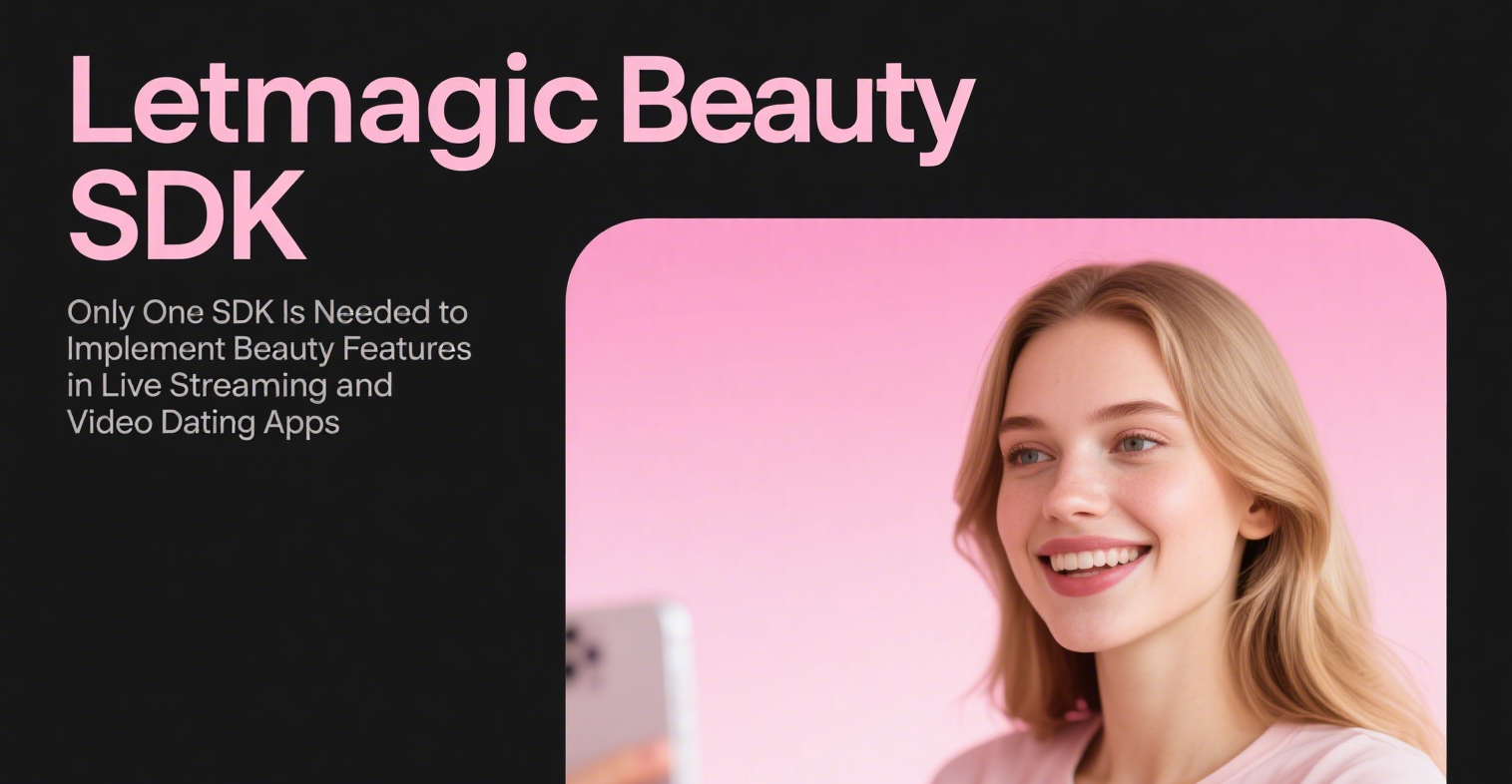 In scenarios such as live-streaming e-commerce and online social interaction, users have increasingly high requirements for the aesthetic quality of real-time video images. Whether it is hosts showcasing products or strangers breaking the ice through video calls, natural and delicate beauty effects have become one of the core competitive edges for apps to retain users. However, under the traditional development model, developing a self-built beauty feature requires investing significant human resources to overcome technical challenges such as face detection, image rendering, and cross-platform adaptation. Not only does the development cycle take several months, but it may also lead to issues like image distortion and lag due to immature algorithms. Today, by integrating a professional beauty SDK, developers can quickly launch beauty features comparable to those of mainstream platforms with just a few lines of code. This not only significantly lowers the technical threshold but also ensures the stability and advanced nature of the effects.
I. How Does a Beauty SDK Cover Core Requirement Scenarios?
A professional beauty SDK usually includes a complete set of functional modules to meet the personalized needs of different apps. At the basic function level, it supports real-time skin smoothing, whitening, face slimming, eye enlargement, and other basic beauty features, while also providing creative effects such as natural virtual makeup, dynamic filters, and AR stickers. For example, tailored to live streaming scenarios, the SDK can implement a "makeup tracking" function to ensure that makeup does not shift when the user turns their head or makes facial expressions; for video dating scenarios, it supports a "subtle beauty" mode, which optimizes skin tone and covers blemishes while preserving the user’s real features, avoiding the "distortion" caused by excessive beautification.
More advanced SDKs also incorporate scenario-specific solutions, such as "product beautification" for live-streaming e-commerce (optimizing color reproduction of clothing and beauty products) or "interactive stickers" for social scenarios (allowing users to trigger AR effects via gestures to enhance fun). These functions do not require separate development by developers—they can be called with one click through the API interfaces provided by the SDK, supporting both iOS and Android platforms, and even multi-terminal scenarios such as mini-programs and Web terminals.
II. How to Ensure Effects and Performance at the Technical Level?
To achieve the dual goals of "natural beauty + smooth operation," a mature technical architecture is required to support the SDK behind the scenes. First, there is AI algorithm optimization: a face key point detection model trained through deep learning can accurately locate 106 facial feature points. Combined with skin tone regional processing technology, it ensures that the skin-smoothing effect is both smooth and retains skin texture, avoiding a "plastic-like" appearance. For instance, a certain SDK adopts a "multi-scale image fusion" algorithm, dividing the facial area into different parts such as the T-zone and cheeks, and adjusting the skin-smoothing intensity for each part separately to achieve "localized refined beauty."
In terms of performance optimization, the SDK is adapted to different hardware. Using GPU parallel computing technology, the beauty processing workflow is broken down into steps such as image preprocessing, effect rendering, and composite output, reducing CPU usage. Test data shows that mainstream SDKs can stably achieve real-time processing at over 30fps on mid-to-low-end Android devices, with GPU usage controlled within 20%, avoiding video lag or overheating caused by the beauty feature. Additionally, the SDK supports "dynamic performance scheduling," automatically adjusting effect parameters based on device performance—enabling full effects on high-performance devices and prioritizing smoothness on low-end devices.
III. What Practical Value Can SDK Integration Bring to Developers?
In terms of development efficiency, a self-built traditional beauty feature requires an algorithm team of at least 5 people and takes 3-6 months to complete a basic version. In contrast, integrating an SDK only requires 1-2 engineers and can be completed in 2-3 days, compressing the launch cycle by over 90%. The person in charge of a social app once revealed that after integrating a beauty SDK, the next-day retention rate of new users increased by 15%, and the duration of video calls increased by 22%. The core reason for this is the significant improvement in user satisfaction with the image quality.
In terms of cost control, SDKs adopt a "pay-as-you-go" model, with tiered pricing based on DAU (Daily Active Users), avoiding high upfront R&D investment. At the same time, SDKs provide comprehensive technical support, including interface documents, demo examples, and 24/7 technical docking services, so developers do not need to worry about post-maintenance issues. For example, when an iOS system update causes changes to camera permissions, the SDK will launch an adapted version as soon as possible to ensure that the feature is not affected.
IV. Future Trend: How to Deeply Integrate Beauty Features with Business?
As user demands evolve, beauty SDKs are expanding from a "tool attribute" to "business empowerment." For example, in combination with live-streaming e-commerce scenarios, SDKs can connect to product library data to implement "virtual makeup testing"—when a user clicks on a lipstick product in a live broadcast room, they can instantly try on the color on their face; in online education scenarios, they support "virtual background replacement," helping teachers quickly switch classroom scenes and improve the teaching experience.
Furthermore, privacy and security have become important considerations. Compliant SDKs use local algorithms to process video data, preventing users’ facial information from being uploaded to the cloud. At the same time, they ensure user privacy security through data desensitization technology. A certain SDK has obtained ISO27001 information security certification, and its "end-side AI computing" solution can complete beauty processing locally on the mobile phone, with data never leaving the device—meeting the privacy requirements of scenarios such as finance and healthcare.
For live streaming and video dating apps, beauty features are no longer a "bonus" but a "necessity." By integrating a mature beauty SDK, developers do not need to get bogged down in technical details. Instead, they can focus their efforts on core business innovation and quickly respond to market demands. In an era where user attention is scarce, achieving high-quality experiences at the lowest cost may be the key to maintaining a competitive advantage.