Beauty SDK Insider: From Key Point Annotation to Triangulation, Unveiling the Technology Behind Natural Beauty Enhancement
In the era of the mobile internet and short video boom, Beauty SDKs have become a "standard configuration" for imaging applications. Users pursue natural, refined, and distortion-free beauty enhancement effects, which rely on two core supporting technologies—facial landmark annotation and triangulation.
These two technologies serve as the cornerstone for beauty algorithms to act on human faces with precision, achieving "natural deformation + texture optimization". Today, we will conduct an in-depth analysis of the key roles of these two modules in Beauty SDKs, from technical principles to development practices.
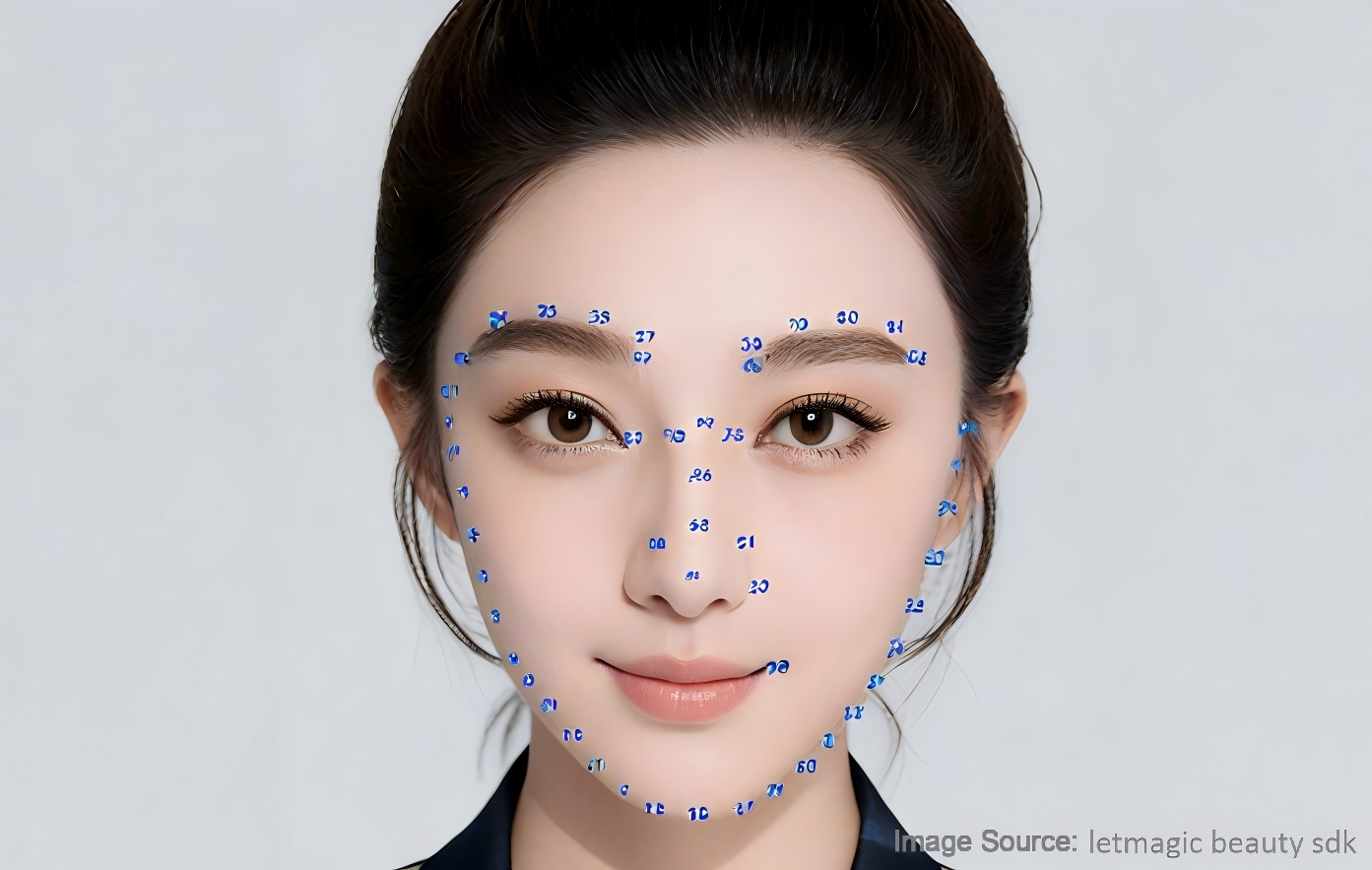
Facial landmarks are coordinate markers for key positions on the human face, covering feature points in areas such as eyebrows, eyes, nose, mouth, and facial contours (as shown in Figure 2, where blue markers are precisely distributed on facial features and contours). These points form the "digital skeleton" of the face, enabling algorithms to understand facial structure and morphology.
In Beauty SDKs, facial landmark annotation serves as the "entry point" for all beauty functions:
- Locating facial feature regions: Precisely demarcating core areas like eyes and lips, providing a scope basis for targeted beauty enhancements such as "eye enlargement" and "lip beautification".
- Capturing facial dynamics: Even when facial expressions change (e.g., smiling, frowning), landmarks can be tracked in real time, ensuring that beauty effects synchronize naturally with facial movements.
- Paving the way for triangulation: Subsequent triangulation relies on these landmarks to construct a geometric mesh of the face (analogous to building a "frame" on top of the "skeleton").
- Data and model selection: For rapid deployment, mature solutions (such as the facial landmark module of LetMagic) can be directly integrated. For customization, models can be trained based on public datasets (e.g., 300-W, AFLW), or secondary development can be conducted using open-source libraries like Dlib.
Accuracy optimization techniques: Commercial-grade SDKs (e.g., LetMagic) need to ensure that landmark errors are within 1-2 pixels. This can be optimized through multi-scale detection (accommodating both large and small faces) and Kalman filtering (smoothing landmark trajectories to enhance dynamic stability).
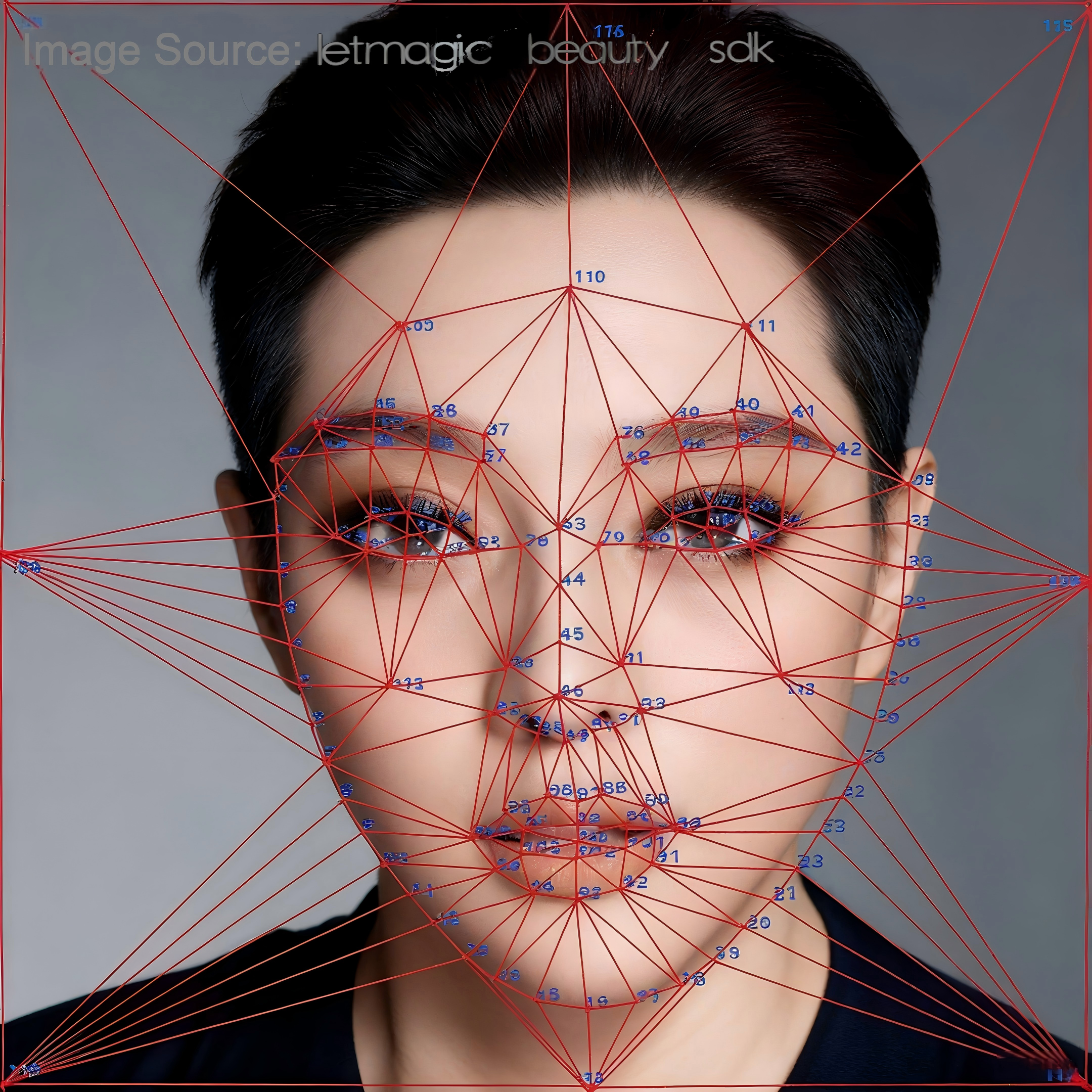
Triangulation is the process of connecting facial regions into a series of triangular meshes via landmarks (as shown in Figure 1, where red lines divide the face into dense triangular surfaces). Since triangles are the most stable planar geometric figures, they maintain "rigidity" and "smoothness" during deformation, making them the optimal choice for facial mesh division.
- Guaranteeing natural deformation: When deformation-based beauty enhancements (e.g., "eye enlargement", "face thinning") are required, algorithms only need to displace the vertices (i.e., landmarks) of the triangular mesh, then alter regional morphology by stretching/compressing the triangles. This method avoids a "distorted look" and enables more natural adjustments to facial proportions.
- Carrier for texture mapping: Texture-based beauty enhancements such as skin smoothing and whitening require pixel-level optimization of skin texture based on triangular meshes. The "texture continuity" of triangles ensures natural transitions in skin after smoothing, eliminating a "patchy appearance".
- Balancing performance and effect: The density of triangular meshes can be flexibly adjusted—denser triangles are used in key areas (e.g., eyes, lips) to preserve details, while sparser triangles are used in contour areas to balance computational performance, achieving "precision beauty enhancement + low-consumption computing".
- Algorithm selection: The Delaunay triangulation algorithm is commonly used, with the core goal of ensuring "optimality" of triangles (minimizing narrow triangles to make the mesh more uniform). Using facial landmarks as vertices, the algorithm automatically generates a triangular mesh covering the entire face.
Layered mesh design: Commercial SDKs "layer" triangular meshes: the bottom layer is a "base mesh" covering the entire face, responsible for overall deformation; the upper layer is a "fine mesh" targeting facial features, responsible for detailed optimization around areas like the eyes and lips.
Facial landmark annotation and triangulation have a "front-end and back-end" relationship:
- Facial landmark annotation provides "coordinate anchors" that define facial structure;
- Triangulation builds a "mesh carrier" based on these anchors, bearing the "deformation" and "texture optimization" of beauty algorithms.
Taking the "eye enlargement" function as an example, the process is as follows:
- The landmark detection model locates landmarks around the eyes (e.g., eye corners, eyelid contour points);
- Triangulation divides the eye area into a triangular mesh;
- The algorithm displaces the vertices (landmarks) of the triangles in the eye area outward while maintaining the rationality of the triangular shape;
Finally, texture interpolation is used to ensure the enlarged eyes look natural and undistorted.
- Rapid deployment: Directly integrate mature third-party modules (e.g., LetMagic Beauty SDK) to save time and effort.
- In-depth customization: Conduct secondary development based on open-source frameworks such as OpenCV+Dlib, focusing on refining the "robustness of landmark detection" and "rationality of triangulated meshes".
- Collect diverse data (different ethnicities, ages, expressions, lighting conditions) for training and testing landmark models;
- Establish internal test sets to verify the naturalness of triangulation under "extreme deformation" (e.g., exaggerated face thinning).
The core competitiveness of Beauty SDKs lies in the details of "facial landmark annotation" and "triangulation"—the former acts as a "decoder" for facial structure, while the latter serves as a "carrier" for beauty effects.
Only by deeply integrating these two technologies can algorithms both "understand" the human face and "naturally transform" it. For developers, starting from technical principles and continuously optimizing through practice is the key to creating truly user-friendly Beauty SDKs.


 I. Introduction: The Underlying Technical Logic of Beauty SDKs