Detailed Explanation of Beauty SDK Function Implementation Technology: Core Technologies for Algorithm Development
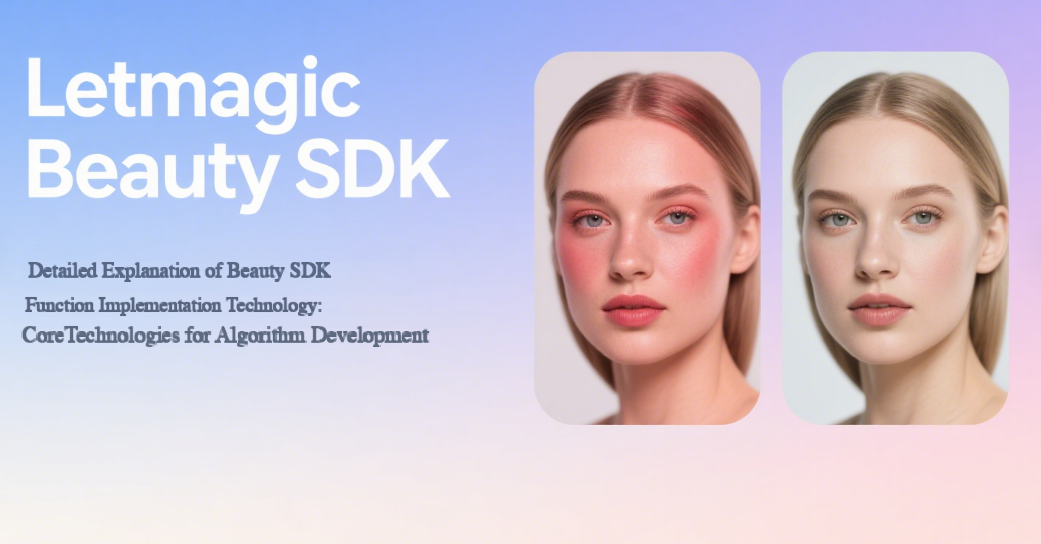
In the mobile internet era, the boom in scenarios such as short videos, live streaming, and online social interaction has transformed the beauty function from an "optional requirement" to a "basic configuration". Whether it is the natural makeup effect of streamers during live broadcasts or the delicate skin smoothing when users take selfies, all rely on the technical support of the Beauty SDK behind the scenes. As a core tool connecting hardware devices and the application layer, the function implementation of Beauty SDK involves technologies in multiple fields such as computer vision, graphics rendering, and real-time computing. Its development process requires finding a precise balance between effect, performance, and compatibility. Starting from the technical bottom layer, this article will explain in detail the core logic of Beauty SDK function implementation and the key points of algorithm development.
The essence of Beauty SDK is a "real-time image processing pipeline", whose core goal is to process the original image collected by the camera through a series of algorithms and output the beauty effect that meets user expectations. A complete technical architecture usually includes four links: data collection layer, preprocessing layer, algorithm processing layer, and rendering output layer. All links need to cooperate closely to ensure real-time performance (usually requiring a delay of less than 100ms).
The data collection layer is the starting point of the link, mainly responsible for obtaining original image data from mobile phone cameras, external devices, or video streams. Two key issues need to be solved here: first, image format adaptation. The output formats of camera sensors (such as CMOS) of different devices may vary (e.g., YUV420, RGB), so the SDK needs to support format conversion to unify the processing standards; second, frame rate stability. The collection frame rate of mobile cameras is easily affected by light and hardware performance, so buffer queues and frame rate compensation algorithms are required to avoid picture freezes.
The preprocessing layer plays the role of "data cleaning" to provide high-quality input for subsequent algorithm processing. Common operations include image denoising (eliminating noise from camera sensors), color correction (unifying white balance deviations of different devices), and distortion correction (correcting edge stretching of wide-angle lenses). For example, in low-light environments, the original image will have obvious noise. At this time, a denoising algorithm based on bilateral filtering is needed—it can not only retain image details but also eliminate high-frequency noise, providing a clean "canvas" for subsequent beauty effects.
The functional diversity of Beauty SDK is essentially the combination and superposition of algorithm modules. From basic skin smoothing and whitening to advanced face slimming and eye enlargement, and then to special effect functions such as virtual makeup and stickers, each function corresponds to a specific algorithm logic. The core algorithm modules can be divided into three categories: face positioning and analysis, basic beauty processing, and special effect enhancement. Together, they form the technical framework of beauty effects.
All beauty effects need to be carried out based on the "face area"—only by accurately identifying the facial contour and the position of facial features can targeted processing such as skin smoothing and face slimming be applied (to avoid misoperation on the background area). Therefore, face positioning and key point analysis are the "prerequisites" of beauty algorithms, and their accuracy directly determines the naturalness of subsequent effects.
Face detection needs to solve the problems of "whether there is a face" and "where the face is". In mobile scenarios, considering the limitation of computing power, lightweight algorithms are usually used: in traditional solutions, Haar features + Adaboost cascade classifiers were widely used due to their fast speed, but their accuracy was relatively low; currently, the mainstream solution is a detection model based on lightweight CNN (Convolutional Neural Network), such as MobileNet-SSD and YOLO-Face. By simplifying the network structure (reducing the depth of convolutional layers and adopting depthwise separable convolution), while ensuring real-time performance (single-frame detection time < 5ms), the accuracy of face detection is increased to more than 99%.
Key point positioning further marks facial feature points (such as the corners of the eyes, wings of the nose, corners of the mouth, jawline, etc.) after a face is detected. The current mainstream solution is "regression-based key point detection", that is, the coordinate of feature points is directly output through a deep learning model (common solutions include 68-point, 106-point, and 194-point positioning). For example, 106-point positioning can cover areas such as eyebrows (10 points), eyes (12 points), nose (18 points), mouth (20 points), and facial contour (46 points), providing precise coordinates for subsequent "regional beauty"—for instance, avoiding details such as eyebrows and eyelashes during skin smoothing to prevent blurring; adjusting the contour curve according to the key points of the jawline during face slimming.
Basic beauty is the most perceptible function for users, including skin smoothing, whitening, ruddy complexion, and sharpening. Its core goal is to make the skin look delicate and smooth while avoiding a "plastic-like" or "distorted" feeling. The development difficulty of such algorithms lies in: how to eliminate skin blemishes (such as acne, spots, and pores) while retaining skin texture (such as fine hair and natural light and shadow transitions), and ensuring the consistency of effects under different lighting environments.
Skin smoothing algorithms are the core of basic beauty. Traditional solutions mainly include three types:
- Gaussian filtering: Realizes skin smoothing by blurring the image, but it also blurs the details of facial features, making the "face look like it has been mosaicked";
- Bilateral filtering: On the basis of Gaussian filtering, a "pixel similarity weight" is added, that is, only pixels that are close in distance and similar in color participate in filtering. It can retain edge details (such as the contour of the nose wings and hairline), but has a large amount of calculation (time complexity O(n²)), which is prone to freezes on low-end models;
- Guided filtering: Uses the original image as a "guided map" to achieve edge preservation through a local linear model. Its computational efficiency is more than 30% higher than that of bilateral filtering, and it can better retain skin texture. Currently, mainstream SDKs mostly adopt the "guided filtering + multi-level blur fusion" solution: first, slightly blur the original image (to eliminate pores), then deeply blur the blemish areas (lock areas such as cheeks and forehead through key point positioning) (to eliminate acne and spots), and finally fuse the processed result with the detail areas (eyebrows, eyelashes, lip lines) of the original image to achieve a natural effect where "blemishes disappear but details remain clear".
Whitening and ruddy complexion algorithms need to be implemented based on "skin area separation". First, the skin area is extracted through face key point positioning (excluding non-skin areas such as hair, eyes, and teeth), and then the effect is achieved through HSV color space adjustment: whitening is realized by increasing the V channel (brightness) value, but the range needs to be limited (usually increased by 10%-20% to avoid overexposure); ruddy complexion is achieved by adjusting the S channel (saturation) and H channel (hue), overlaying a light pink/light red tone on the skin area. At the same time, through skin color threshold control (e.g., limiting the skin color to the range of [H:0-30, S:0.2-0.6, V:0.4-0.9]), color overflow to non-skin areas is avoided.
With the upgrading of user needs, Beauty SDK has gradually expanded from "static skin beautification" to "dynamic effect enhancement", such as face slimming, eye enlargement, virtual makeup, and sticker functions. Such algorithms need to combine 3D facial deformation and real-time rendering technology to achieve "effect following based on dynamic changes of the face".
The core of face slimming and eye enlargement algorithms is "mesh deformation": a "facial mesh model" is constructed based on face key points (dividing the face into hundreds of triangular meshes), and then the mesh vertex coordinates are adjusted to achieve deformation. For example, during face slimming, according to the coordinates of the jawline key points (such as from point 68 to point 90), the mesh is contracted inward through the "Laplacian deformation" algorithm (the contraction range is related to the user-adjusted parameters), and the deformation range is limited at the same time (to avoid pulling areas such as the neck and ears); during eye enlargement, the key points of the eye contour (such as the inner corner of the eye, outer corner of the eye, upper and lower eyelids) are adjusted to expand the mesh of the eye area outward, and "edge smoothing" is used to avoid the "angular feeling" of the eyes after deformation.
Virtual makeup and sticker special effects need to combine "texture mapping" and "real-time rendering" technologies. The implementation logic of virtual makeup effects (such as lipstick, eyeshadow, and blush) is: first, lock areas such as lips, eyelids, and cheekbones through key point positioning, then map the preset makeup texture map (such as the color texture of lipstick and the pearlescent texture of eyeshadow) to the corresponding areas through "UV mapping", and update the texture coordinates in real time according to the facial posture (such as turning the head and raising the head). This requires calling the graphics rendering interface of the device's GPU (such as OpenGL ES, Metal) and realizing texture blending through shaders (e.g., the "overlay" blending mode of lipstick, which allows the color to blend naturally with the original skin color of the lips). Sticker special effects (such as cartoon ears and dynamic stickers) need to be realized through "feature point tracking": the sticker anchor points are bound to the face key points (e.g., ear stickers are bound to the tragus key points). When the face moves, the sticker coordinates are updated in real time with the key points, and "perspective projection" is used to simulate the near-far scaling of the sticker (e.g., the sticker becomes larger when the face is close to the camera and smaller when it is far away).
The development of Beauty SDK not only needs to "achieve good effects" but also "run smoothly". The computing power of mobile devices (especially mid-to-low-end models) is limited (CPU frequency is usually 1.5-2.5GHz, and GPU performance varies greatly), and they need to run tasks such as camera collection, network transmission, and application logic at the same time. Therefore, the computing resources left for beauty algorithms are very tight. Therefore, performance optimization is a "required course" for SDK development, and its core goal is: on the premise of ensuring the effect, control the single-frame processing time within 30ms (corresponding to 30fps frame rate) and the memory usage below 50MB.
Algorithm-level optimization mainly has three directions:
- Model lightweight: For deep learning models such as face detection and key point positioning, through methods such as "model pruning" (removing redundant neurons), "quantization compression" (converting 32-bit floating-point parameters to 8-bit integers), and "knowledge distillation" (training simple models with complex models), the model size is compressed from more than 10MB to less than 2MB, and the inference speed is increased by more than 50%;
- Computation area cropping: Only perform algorithm processing on the face area, and directly bypass the non-face area (obtain the face bounding rectangle through key point positioning and process it after cropping), which can reduce the amount of computation by more than 60%;
- Hardware acceleration call: Make full use of the parallel computing capability of the mobile GPU, implement filtering operations such as skin smoothing and whitening through OpenGL ES Shader (GPU processes pixels in parallel, which is more than 10 times faster than CPU), and call hardware interfaces such as NNAPI (Android Neural Network API) and Core ML (iOS Machine Learning Framework) at the same time to run deep learning models on NPU (Neural Processing Unit), further reducing CPU load.
Compatibility optimization is also crucial: the camera parameters (such as resolution and frame rate) and GPU models (such as Adreno and Mali) of different devices vary greatly, so a "hierarchical adaptation strategy" is needed to solve this problem—for example, enabling 1080P 60fps full-effect beauty for high-end models (such as Snapdragon 888, Dimensity 92xx); disabling some real-time rendering special effects (such as dynamic light spots) for mid-end models (such as Snapdragon 6 series); adopting simplified algorithms (such as 68-point positioning instead of 106-point positioning, and basic skin smoothing instead of multi-level fusion skin smoothing) for low-end models (such as MediaTek MT67xx) to ensure "smooth operation without freezes".
With the maturity of AI technology, the algorithms of Beauty SDK are evolving from "rule-based processing" to "intelligent optimization". For example, traditional skin smoothing relies on manual parameter adjustment (such as filter radius and blur intensity), while AI skin smoothing can automatically identify the user's skin type (dry, oily, sensitive) by training a "skin quality evaluation model" and dynamically adjust the skin smoothing parameters (strengthen pore elimination for oily skin and retain more texture for dry skin); AI virtual makeup can automatically transfer the reference makeup uploaded by the user (such as celebrity-style lipstick) to the face through a "style transfer model", realizing a personalized effect of "one look for one person".
At the same time, breakthroughs in real-time rendering technology (such as the popularization of WebGPU and the support of mobile ray tracing) make beauty special effects more close to the real physical world. In the future, Beauty SDK will not only realize "skin smoothing and whitening" but also simulate the skin texture under different light sources (such as transparency under sunlight and ruddy complexion under warm indoor light), and even combine virtual fitting and AR interaction to upgrade beauty from a "static beautification tool" to a "virtual-real fusion interactive platform".
The technical development of Beauty SDK is essentially "technology iteration driven by user experience". From simple blurring in the early stage to natural texture now, and from single function to multi-scenario adaptation, every effect upgrade is the comprehensive result of algorithm optimization, performance tuning, and hardware adaptation. In the future, with the improvement of end-side AI computing power and the relaxation of graphics rendering technology constraints, Beauty SDK will continue to make breakthroughs in three dimensions: "naturalness of effect", "real-time interaction", and "personalized customization", bringing users a more real, intelligent, and immersive visual experience.