Advanced Development of Beauty SDK: A Detailed Guide to Building Beauty Enhancement, Facial Shaping, Filter, and Intelligent Beauty Functions
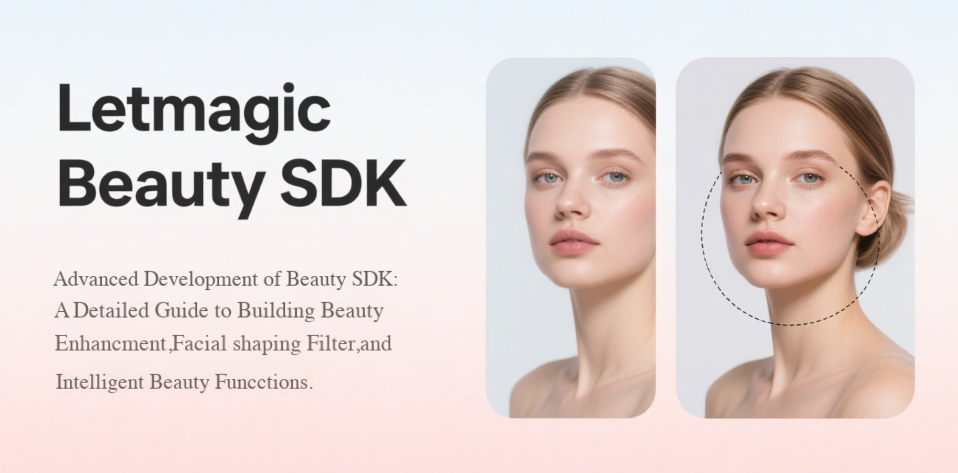
In the era of mobile internet visual economy, Beauty SDK has become a core component of image-related applications. From short video creation to online live streaming, and from social interaction to content production, users' demands for real-time beauty effects are constantly upgrading, driving technology to evolve from basic skin smoothing to intelligent and scenario-based solutions. This article systematically breaks down the core technical modules of Beauty SDK, explores the implementation principles of beauty enhancement, facial shaping, and filter systems, as well as the technical architecture of intelligent beauty functions, providing developers with a practical guide from basic to advanced levels.
The core of beauty enhancement functions lies in achieving natural beautification while preserving facial details, which requires balancing the authenticity of effects and performance overhead. The basic beauty enhancement module typically includes the following technical links:
Facial key regions are located using face detection algorithms (such as MTCNN and RetinaFace) to generate ROI (Region of Interest) masks, avoiding ineffective processing of background pixels. To improve real-time performance, GPU parallel computing can be used to accelerate facial key point detection. Currently, mainstream solutions can achieve sub-millisecond response for 68-point or 98-point key points.
Traditional skin smoothing mostly uses Gaussian blur or bilateral filtering, but these methods easily lead to the loss of facial details. Modern solutions generally adopt layered processing based on Guided Filter:
- Low-frequency layer: Preserves lighting and skin tone base, and eliminates spots and acne marks through adaptive blur.
- High-frequency layer: Retains detailed features such as eyebrows, eyelashes, and hair strands, with intensity retention controlled by thresholds.
- Fusion strategy: Dynamically adjusts skin smoothing intensity through a skin tone probability map to avoid the "plastic-like effect" caused by excessive blurring.
Skin tone adjustment based on the CIELAB color space can achieve more natural whitening effects:
- Separate skin tone components (L* brightness channel, a* red-green channel, b* yellow-blue channel).
- Perform gamma correction on the L channel to increase brightness while preserving highlight details.
- Identify non-skin tone regions (such as lip makeup and eyeshadow) using a skin tone clustering algorithm to avoid color distortion.
Facial shaping functions need to realize natural adjustment of facial contours while ensuring stability under dynamic expressions. The core challenge lies in balancing deformation accuracy and real-time rendering.
Triangular meshes (Delaunay triangulation) are constructed using detected facial key points, and facial deformation is achieved through the displacement of mesh vertices. To improve naturalness, a multi-level mesh system needs to be established:
- Coarse mesh: Controls the overall contour such as face shape and jawline.
- Fine mesh: Adjusts local features such as eye spacing, nose bridge, and lip shape.
- Dynamic topology: Adjusts the mesh connection relationship in real time according to expression changes to avoid expression distortion.
Mainstream SDKs usually provide more than 20 adjustable parameters, with core parameters including:
- Face shape: Achieve effects such as oval face and heart-shaped face through the displacement of jawline key points.
- Eyes: Stretching of inner/outer eye corners, adjustment of eyelid height, and eye enlargement (controlled within 1.2 times to avoid distortion).
- Nose: 3D adjustment of nose bridge height, nose tip size, and nostril width.
- Lips: Control of lip peak sharpness, lip thickness, and corner lift angle.
To solve the "collapse" problem during expression deformation, an expression smooth transition mechanism needs to be introduced:
- Establish an expression base matrix (based on AU facial action units).
- Predict the trend of expression changes through an LSTM network and generate deformation buffer frames in advance.
- Use a spring damping model to control the displacement speed of key points and avoid sudden changes.
Filter functions have evolved from simple color overlay to comprehensive rendering systems including material simulation and light effects, which need to balance the richness of effects and performance optimization.
- LUT (Lookup Table) technology: Realizes fast color mapping through 256x256 or 512x512 color lookup tables, supporting real-time switching of more than 300 filter effects.
- Multi-layer blending modes (such as multiply, screen, and soft light) to simulate film texture, with filter intensity controlled through the Alpha channel.
- Real-time color adjustment parameters: Dynamic adjustment of exposure, contrast, saturation, and color temperature, supporting user-defined parameter combinations.
- Makeup effects: Facial sticker mapping based on UV unwrapping, supporting dynamic overlay of eyeshadow, lip gloss, and blush.
- 3D filters: Combining spatial positioning of ARKit/ARCore to realize real physical interaction between virtual props and the face.
- Style transfer: Lightweight GAN models (such as MobileStyleGAN) to achieve real-time conversion of artistic styles such as oil painting and sketching, which need to be compressed to less than 5MB through model quantization.
- Filter chain merging: Merge multiple consecutive filter operations into a single GPU shader program to reduce the number of texture samplings.
- Resolution-level processing: Precompute filter effects at low resolution and upscale to the target size through bilinear interpolation.
- Hardware acceleration adaptation: Optimize shader code for different GPU architectures (Adreno/Mali) to avoid color discontinuity caused by precision deviations.
Intelligent beauty realizes personalized beautification from "one-size-fits-all" to "personalized for each user" through AI algorithms. The core lies in understanding user characteristics and scenario requirements.
- Appearance attribute extraction: Analyze facial features through a CNN model to generate labels such as face shape (round/long face), skin type (dry/oily), and facial proportion.
- Age and gender recognition: Used to adapt beautification strategies for different age groups (such as enhancing facial three-dimensionality in children's mode).
- Expression state judgment: Detect expressions such as smiles and blinks, and dynamically adjust facial shaping parameters to avoid expression distortion.
- Light adaptation: Use ambient light sensor data to enhance fill light effects in backlit scenarios and reduce skin smoothing intensity to preserve details in low-light environments.
- Scenario recognition: Identify shooting scenarios (portrait/landscape/food) by combining image classification models and automatically switch corresponding filter styles.
- Content compliance detection: Real-time identification of sensitive makeup (such as excessive face slimming and exaggerated eye shaping) and trigger a compliance early warning mechanism.
- Model lightweight: Compress large models into end-side applicable lightweight models using Knowledge Distillation.
- Inference acceleration: Realize heterogeneous computing scheduling of GPU/CPU/NPU through inference frameworks such as NNAPI or MNN/TNN.
- Dynamic loading strategy: Load models in grades according to device performance. Mid-to-low-end models enable basic beauty functions by default, while high-end models unlock AI-enhanced functions.
The development of Beauty SDK needs to solve three major engineering challenges: real-time performance, compatibility, and stability. It is recommended to build a technical system from the following dimensions:
- Unified rendering pipeline: Build a cross-platform rendering framework using OpenGL ES/Metal/Vulkan and encapsulate platform-specific interfaces.
- Device performance grading library: Establish a performance evaluation model based on GPU model, CPU core count, and memory capacity, and dynamically adjust processing resolution (adaptive 720P/1080P).
- Compatibility test matrix: Cover mainstream models with Android 5.0+ to 13.0 and iOS 10+ to 16.0, focusing on solving rendering anomalies in low-end devices.
- Target frame rate: Ensure a smooth experience of more than 30fps, and no less than 24fps in complex special effect scenarios.
- Startup time: Control cold start loading time within 300ms and hot start within 50ms.
- Memory usage: Memory consumption of basic function modules ≤15MB, and ≤40MB when all functions are enabled.
- A/B testing system construction: Quantify the attractiveness of beauty effects through user behavior data (dwell time, sharing rate).
- Aesthetic parameter database: Collect millions of user samples to establish beautification preference models for different regions, ages, and genders.
- Dynamic effect adjustment: Intelligently predict beautification needs based on the strength and direction of user sliding operations, and provide progressive adjustment feedback.
Currently, Beauty SDK technology is developing towards being more intelligent, realistic, and immersive:
- Integration with virtual digital humans: Combine beauty technology with 3D digital human driving to realize real-time facial expression migration.
- Metaverse scenario adaptation: Support stereoscopic beauty on VR/AR devices and solve the depth consistency problem under binocular vision.
- Privacy-preserving computing: Adopt federated learning technology to optimize beauty models without user data leaving the end device.
For developers, it is necessary to continuously pay attention to the evolution of mobile computing power (such as NPU-specific AI chips), innovations in graphics technology (such as mobile adaptation of ray tracing), and changes in user aesthetic trends, so as to find the optimal balance between technical implementation and user experience.
The development of Beauty SDK is a comprehensive practice integrating computer vision, graphics, AI algorithms, and engineering optimization, which requires balancing technical depth and product thinking. From basic skin smoothing and whitening to intelligent scenario-based beautification, the core lies in understanding users' essential needs for "natural authenticity"—the ultimate goal of technology is not to create a perfect virtual image, but to help users show a more confident real self through moderate beautification. In the future, with the improvement of mobile computing power and the iteration of algorithm models, beauty technology will further break the boundary between reality and virtuality, bringing more possibilities to visual content creation.