Behind "One-Click Beauty": In-Depth Exploration of Beauty SDK Technology for Live Streaming and Video Dating
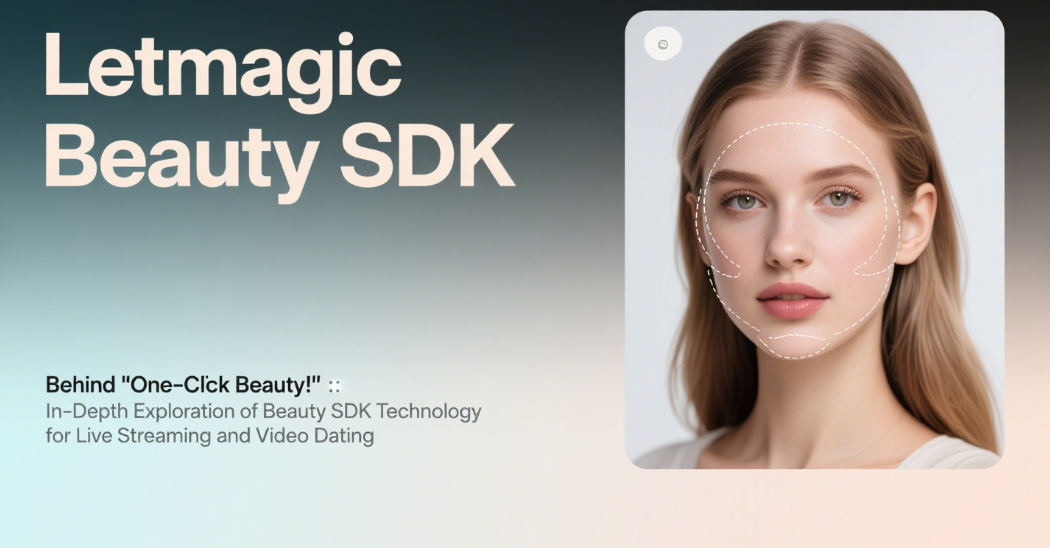
Open a live streaming app, click the beauty button at the bottom of the screen, and your skin instantly becomes smooth and your facial features more three-dimensional—this has become a "routine operation" for users in today’s live streaming and video dating scenarios. From "appearing with a bare face" to "looking refined with one click", behind this seemingly simple function lies a complex technical system integrating computer vision, graphics, and artificial intelligence, known as the "Beauty SDK". As a core tool connecting user needs and technical implementation, Beauty SDK is redefining the visual experience of real-time interaction scenarios through its continuously evolving algorithm capabilities.
Beauty SDK (Software Development Kit) is not a single "beauty button", but a collection of technologies integrating functions such as face detection, image beautification, and real-time rendering. For live streaming and video dating platforms, developing a complete set of beauty technologies directly is costly and time-consuming. However, by encapsulating mature algorithm modules, Beauty SDK allows developers to quickly integrate functions through "interface calls"—it’s like equipping the app with "wings" for beauty enhancement. Users don’t have to wait for the platform’s self-developed solutions to enjoy basic functions such as skin smoothing, face slimming, and eye enlargement, as well as advanced experiences like AR effects and virtual avatars.
Today’s Beauty SDK has evolved from an early "basic beautification tool" to an "experience optimization engine". Take a leading video dating platform as an example: the Beauty SDK it has integrated not only supports real-time beauty enhancement but also automatically adjusts skin smoothing intensity according to the light environment (reducing skin smoothing under strong light to avoid excessive blurring and enhancing detail retention under weak light). It even recommends suitable beauty parameters based on the user’s facial features (such as round face or long face)—this "personalized for each individual" optimization capability is a reflection of the in-depth technical strength of the SDK.
The smooth experience of "one-click beauty" relies on the collaborative operation of underlying technical modules. The entire process from the camera capturing images to the user seeing the beauty effect must be completed within 100 milliseconds (the human eye perceives lag when the delay exceeds 100 milliseconds), which requires each technical link to be accurate and efficient.
The first step in beauty enhancement is to enable the algorithm to "find the face". Using computer vision technology, the SDK locates the face area in real time from the video stream (eliminating background interference) and marks key feature points—usually 68 or 106 coordinate points including the eyes, eyebrows, nose, mouth, and jawline (professionally called "facial feature points"). These points are like the "navigation coordinates" for beauty enhancement; subsequent operations such as skin smoothing and face slimming are executed precisely based on these coordinates.
For example, the "face slimming" function does not simply stretch the image, but adjusts the position of the key points on the jawline to achieve a "shrinking" effect while maintaining a natural transition of the facial contour. The "eye enlargement" function, on the other hand, locates the feature points on the edge of the eyeball, enlarges the iris area while keeping the proportion of the sclera (white of the eye) balanced, avoiding distorted issues like "crossed eyes".
After localization, the core beautification algorithms come into play. Currently, mainstream beautification technologies can be divided into two categories: "traditional image processing" and "AI deep learning". These two types are used in combination to balance effect and efficiency.
Skin smoothing is the most basic demand. In the early days, it was achieved through Gaussian blur, but this easily led to the loss of details (such as blurry hair and eyebrows). The current mainstream "bilateral filtering" algorithm can smooth skin texture while retaining high-frequency details like pores and hair strands—its principle is similar to "intelligent blurring": it only blurs areas with similar skin tones (such as acne marks and spots) while preserving edges of clear features like eyebrows and eyelashes.
Whitening is achieved by adjusting the brightness channel and color balance of the image. The SDK dynamically optimizes based on the ambient light: under warm light, it reduces the proportion of the yellow channel to avoid a "pale" look; under cold light, it enhances the red channel to make the skin tone appear more ruddy.
With the maturity of deep learning technology, AI has begun to undertake more complex tasks in beauty enhancement. For instance, the "skin texture analysis" algorithm can identify the user’s skin type (dry, oily, sensitive) through a trained neural network and automatically adjust the intensity of skin smoothing—strengthening oil control effects for oily skin and reducing skin smoothing for sensitive skin to avoid excessive blurring of redness-prone areas.
The more advanced "three-dimensional shaping" function converts 2D flat images into 3D facial models using 3D face reconstruction technology. Then, it adjusts the height of the nose bridge and the fullness of the cheekbones according to the facial bone structure to achieve effects such as "natural nose enhancement" and "cheekbone plumping", avoiding the "flat distortion" of traditional 2D beauty enhancement.
Real-time processing of video streams has extremely high performance requirements. Assuming a video frame rate of 30 frames per second, each frame needs to go through steps such as face detection, key point localization, and beautification processing—tasks that ordinary mobile phone CPUs can hardly handle. Therefore, Beauty SDK needs to improve efficiency through "hardware acceleration"—for example, calling the mobile phone’s GPU (Graphics Processing Unit) to process image data in parallel, or using dedicated AI chips (such as Apple’s Neural Engine and Android’s NPU) to accelerate the operation of deep learning algorithms.
Test data from a certain SDK vendor shows: without hardware acceleration, mid-range mobile phones process high-definition video (1080P) with a beauty frame rate of approximately 15 frames per second (obvious lag); after enabling GPU acceleration, the frame rate can be increased to 28 frames per second, approaching the smoothness standard; if combined with NPU optimization, the frame rate can reach more than 30 frames per second, and power consumption is reduced by 40% (preventing the mobile phone from overheating).
Despite continuous technological progress, Beauty SDK still faces two core challenges: balancing naturalness and authenticity, and compatibility across multiple devices.
In the early days, due to algorithm limitations, beauty enhancement often led to problems such as "looking like a mask due to over-smoothing" and "distorted face slimming", and even caused social awkwardness like "looking completely different in person". Today, users’ demands for beauty enhancement have shifted from "the more beautiful, the better" to "beautiful but not fake", which requires SDKs to find a balance between beautification intensity and authenticity.
Solutions include:
- Dynamic Threshold Control: AI analyzes facial features to set a "beautification upper limit"—for example, the face slimming range does not exceed 15% of the facial width, and eye enlargement does not exceed 20% of the eyeball diameter, avoiding proportional imbalance.
- Detail Retention Technology: Adopting a "zoned processing" strategy—smoothing the skin area while enhancing the sharpness of detailed areas such as eyebrows, eyelashes, and lip lines to retain the "authentic texture" of the face.
There are huge differences in hardware performance among different mobile phones (from budget phones to flagship models). How to maintain consistent beauty effects across various devices? SDK vendors need to achieve this through "hierarchical adaptation":
- High-end models: Enable advanced functions such as AI skin texture analysis and 3D three-dimensional shaping;
- Mid-range models: Retain basic beautification + lightweight AI optimization;
- Budget phones: Simplify algorithm logic and prioritize frame rate guarantee (such as reducing the number of feature points to 68 and disabling 3D functions).
At the same time, parameters are adjusted remotely through a "cloud configuration center"—for example, if a certain budget phone is detected to be running with lag, the complexity of the skin smoothing algorithm can be automatically reduced to ensure user experience.
The value of Beauty SDK has long gone beyond being a "beautification tool" itself. For live streaming platforms, beauty functions can increase users’ willingness to start live broadcasts (data shows that the camera activation rate of users increases by 60% after enabling beauty enhancement); for video dating apps, natural beauty effects can reduce users’ social pressure and promote ice-breaking interactions between strangers. According to statistics from a video dating platform, after integrating the intelligent Beauty SDK, the average daily call duration of users increased by 2 minutes, and the payment rate increased by 15%.
In the future, with the in-depth integration of AI and AR technologies, Beauty SDK will extend in broader directions:
- Virtual-Real Integration Experience: Combining AR technology to realize "virtual makeup trial live streaming" (users try on lipstick colors while live streaming) and "real-time outfit change for dating" (switching virtual clothing during video calls);
- Personalized Beauty Enhancement: Recommending solutions based on the user’s social scenario—"natural light makeup" for workplace live streams, "stage effects" for entertainment live streams, and "original beauty enhancement" for video blind dates;
- Enhanced Privacy Protection: All beauty processing is completed locally (data is not uploaded to the cloud) to avoid leakage of facial feature data, which will become one of the core competitiveness of SDKs in the future.
From "blurry skin smoothing" to "AI intelligent beautification", the iteration history of Beauty SDK technology is also the evolution history of user experience in real-time interaction scenarios. Driven by the dual demands of "appearance economy" and "authentic social interaction", this technical system is transforming "one-click beauty" from a simple function into an "emotional bridge" connecting users with the digital world through more refined algorithms, more efficient performance, and more personalized experiences. In the future, with continuous technological breakthroughs, we may see that beauty enhancement is no longer "retouching", but the "optimal visual expression" based on personal characteristics—allowing everyone to show a more confident version of themselves in front of the camera.