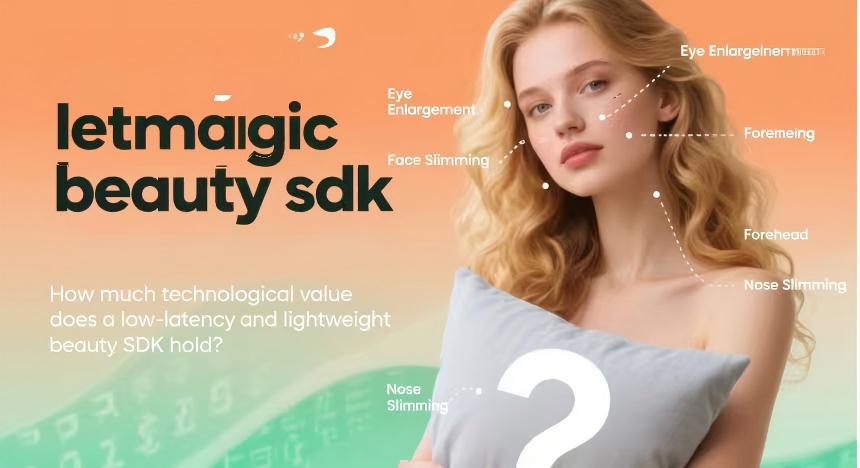
In the mobile internet era, beauty features have become a standard configuration for applications such as video social networking, live streaming, and online education. Users' demands for beauty functions have long gone beyond "beautification" itself, focusing more on "fast response" and "stable operation".
Low-latency, lightweight Beauty SDKs may seem simple in function, but they are actually the product of in-depth integration of multi-disciplinary technologies. Their technological value lies in the meticulous refinement of technology in every detail.
Traditional Beauty SDKs often fall into the contradiction between "effect and performance": pursuing sophisticated effects leads to heavy computation, causing stutters and delays on mid-to-low-end devices; while emphasizing lightweight performance easily results in distorted effects and loss of details. The core goal of low-latency, lightweight Beauty SDKs is to find the optimal balance among natural effects, smooth operation, and low resource consumption. This goal has directly driven technological breakthroughs in multiple dimensions.
The competitiveness of low-latency, lightweight Beauty SDKs stems from the accumulation of core technologies in fields such as image processing, resource management, and real-time computing, which are specifically reflected in the following five dimensions:
The core of beauty functions lies in a complex image processing chain, covering multiple links such as face detection, key point positioning, skin texture optimization, and filter rendering. The primary breakthrough of lightweight SDKs is the "subtractive reconstruction" of core algorithms:
- Region-Specific Refined Processing: Abandoning the extensive "full-face unified algorithm" model, differentiated algorithms are designed for different regions such as skin, facial features, and contours. For example, during skin smoothing, an optimized bilateral filtering algorithm is used for large areas like cheeks to quickly remove blemishes; while guided filtering is applied to detailed areas such as eyelids and nose wings to retain textures and avoid a "plastic-like" appearance.
Algorithm Model Simplification: The amount of computation is reduced through mathematical model optimization, such as dimensionality reduction of high-dimensional matrix operations. On the premise of ensuring effect accuracy, the algorithm complexity is reduced by more than 30%.
The core of "lightweight" lies in the ultimate control of resources such as CPU, GPU, and memory, which requires full-link engineering optimization:
- Modular On-Demand Loading: Beauty functions are disassembled into independent modules (such as skin smoothing, eye enlargement, and filters). Required modules are dynamically loaded according to application scenarios to prevent idle functions from occupying memory.
- Hardware Collaborative Scheduling: Computing tasks are accurately allocated — serial tasks such as logical judgment are assigned to the CPU, while parallel tasks such as image rendering are handled by the GPU. In-depth adaptation to mobile hardware acceleration interfaces such as OpenGL ES and Metal is achieved, and efficient processing programs are written using Shader language, increasing GPU utilization by more than 40%.
Ultimate Memory Compression: The storage format of image data is optimized, and the number of data copies is reduced, controlling the memory usage of a single frame of image to within 60% of that of traditional SDKs.
Scenarios such as live streaming and video calls have extremely low tolerance for latency (usually requiring ≤10ms), which places strict requirements on the real-time processing capability of the SDK:
The naturalness of beauty effects completely depends on the accuracy of face key point detection and tracking. Lightweight SDKs achieve breakthroughs through an integrated solution of "traditional algorithms + lightweight AI":
- Lightweight Model Training: Based on millions of annotated data, a deep learning detection model with only 1/5 the number of parameters of traditional models is trained. It can identify 68 core key points with a detection speed of 50ms per frame.
Dynamic Robustness Optimization: Key points are predicted and corrected by combining light sensor data and inter-frame context information. Even in complex scenarios such as backlighting, side faces, and exaggerated expressions, the tracking accuracy remains above 95%.
The fragmentation of mobile devices is a huge challenge for SDK adaptation. Excellent lightweight SDKs need to ensure stability through systematic solutions:
- Full-Scenario Testing System: Covering mainstream iOS and Android system versions, real-device testing is conducted on more than 2,000 devices of different brands and configurations, including extreme environments such as low temperature and low battery.
Rapid Problem Response Mechanism: A device feature database is established, and device models are automatically matched through user feedback to achieve accurate positioning and repair of BUGs, increasing the adaptation response speed to within 24 hours.
The technological value of low-latency, lightweight Beauty SDKs is not reflected in the radical breakthrough of a single technology, but in the dynamic balance among "effect, performance, and compatibility". Behind every 1ms reduction in latency and every 1% decrease in CPU usage lies the accumulation of dozens of algorithm iterations, hundreds of device tests, and thousands of lines of code optimization.
This technical refinement is ultimately transformed into a user-perceivable experience: achieving high-definition live streaming without stutters on budget smartphones, real-time beauty without latency in video calls, and natural beauty effects even in complex environments — this is the ultimate embodiment of its technological value.