

Updated:2025-09-30
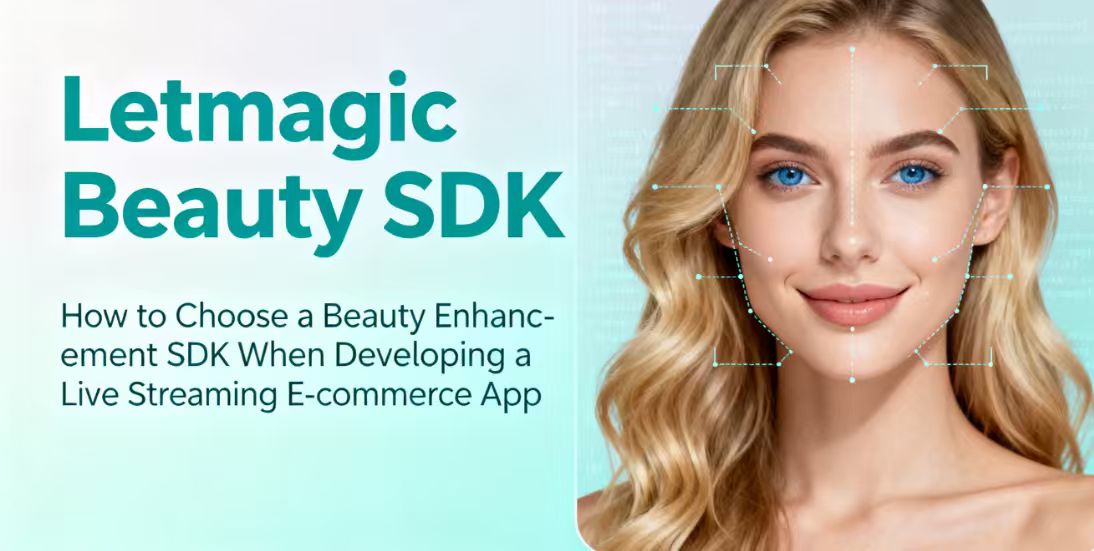
The Selection of Beauty SDK for Live Streaming E-commerce: Core Dimensions and Practical Recommendations
Amid the vigorous development of the live streaming e-commerce industry, the host's on-screen image directly affects user trust, willingness to interact, and product conversion rates. As a core tool for optimizing the host's on-screen appearance, the Beauty SDK has become an "essential component" for live streaming e-commerce applications.
Choosing the right Beauty SDK can not only enhance the professionalism of the product but also indirectly boost sales conversion; choosing the wrong one may drive users away due to issues such as distorted effects and lags.
Starting from the characteristics of the live streaming e-commerce scenario, this article breaks down the six core dimensions for selection and provides practical recommendations.
1. Core of Selection: Focus on the Scenario-specific Features of Live Streaming E-commerce
The core difference between live streaming e-commerce and regular entertainment live streaming lies in "trust-building and product conversion". This determines that the selection of a Beauty SDK must balance three core requirements: "natural effects", "stable operation", and "functional adaptation to e-commerce scenarios". It should not only enhance the host's affinity through beauty effects but also avoid distorting the true presentation of products due to excessive beautification. At the same time, it needs to adapt to high-frequency scenarios such as long-duration live streams and multi-device broadcasting.
2. Six Core Dimensions: Comprehensive Evaluation of Beauty SDK Adaptability
1. Beauty Effect: Naturalness and Authenticity Are the Foundation of Trust
The core of live streaming e-commerce is "matching hosts with products". Beauty effects should serve the purpose of "building trust" rather than "covering up the truth", with a focus on the following three aspects:
Delicacy of Basic Effects: Skin smoothing should retain skin textures (such as pores and foundation texture) to avoid a "mask-like" appearance. Beauty functions like skin whitening, face slimming, and eye enlargement should conform to facial bone structures, achieving "natural subtle adjustments" rather than "excessive deformation" to prevent viewers from having doubts about the authenticity of the host or products.
Light Adaptability: It should adapt to complex lighting conditions commonly seen in live streams (such as indoor fill lights, outdoor backlighting, and overhead lights in live broadcast rooms). It should not appear overexposed under strong light or blurry under weak light, ensuring the host's image remains consistent and stable across different scenarios.
Product Adaptability: For products that require detailed display, such as cosmetics and clothing, the beauty algorithm should avoid "generalized processing". For example, in cosmetics live streams, details like lipstick colors and eyeshadow layers should be retained to prevent distorted product effects caused by excessive beautification.
2. Performance: Stability and Smoothness Are the Bottom Line for Live Streaming
Live streaming e-commerce requires long-duration (often 4-8 hours) and high-concurrency operation. Poor performance directly leads to live stream interruptions or user loss, so the following aspects need to be tested with emphasis:
Real-time Performance and Smoothness: The delay in beauty processing should be ≤15ms, and the frame rate should be stably maintained above 30fps without stuttering or frame drops. It should perform stably especially on mid-to-low-end Android devices (such as budget smartphones under 1,000 yuan) — the devices commonly used by hosts are not necessarily high-end, so performance adaptation is crucial.
Resource Usage Control: CPU usage should be ≤20% and GPU usage ≤30% to avoid device overheating and rapid power consumption during long live streams (full battery life should support more than 4 hours of use), preventing live stream interruptions due to device shutdown.
Multi-task Compatibility: It should adapt to multi-task scenarios such as "live streaming + pop-up interaction + product listing". The beauty function should not crash or fail due to background process switching.
3. Feature Richness: Adapting to Interaction and Conversion Needs in E-commerce Scenarios
In addition to basic beauty functions, features should meet the needs of "atmosphere creation" and "product display" in live streaming e-commerce, with a focus on the following core aspects:
Scenario-specific Effect Library: Provide effects matching the product category — virtual makeup testing (lipstick and eyeshadow color testing) for cosmetics live streams, virtual fitting for clothing live streams, and "appetite filters" (enhancing color saturation) for food live streams. It should also support festive effects (such as 618 and Double 11 themed stickers) to enhance interaction.
Practical Tool Functions: It should include functions such as green screen keying (replacing the live broadcast room background with product posters), dynamic stickers (highlighting information like "limited-time flash sales" and "lucky bags"), and beauty parameter presets (saving personalized settings for different hosts' face shapes).
Scalability: Provide open APIs to support secondary development, such as connecting to the product library to realize "clicking on lipstick effects to jump directly to product links", or automatically adjusting the intensity of beauty effects based on the number of viewers in the live room (the more viewers, the more natural the effect).
4. Integration and Technical Support: Reducing Development Costs and Ensuring Operational Stability
Live streaming e-commerce applications have a fast iteration pace. The "ease of integration" and "after-sales support" of the SDK directly affect the launch efficiency, so the following aspects need to be evaluated:
Integration Threshold: Provide comprehensive development documents (including exclusive demos for live streaming scenarios), simple API interfaces (integration cycle ≤3 working days), support for both Android and iOS platforms, and compatibility with mainstream live streaming frameworks (such as Tencent TRTC and NetEase Yunxin RTC).
Problem Response Speed: Technical support should provide 24/7 service, with dedicated customer service for peak live streaming periods (such as major promotions). The response time for bug fixes should be ≤4 hours — every minute and second counts when a live stream is interrupted.
Version Iteration Capability: Update the effect library at least once a month, promptly adapt to new systems (such as Android 14 and iOS 18) and new devices (such as the latest iPhone and Android flagship phones), and avoid functional failures caused by system upgrades.
5. Security and Compliance: Avoiding Privacy and Legal Risks
The Beauty SDK processes the host's facial data, so compliance is the bottom line for the survival of enterprises. The following aspects need to be verified:
Data Security Mechanism: Facial data should be processed locally (without being transmitted to third-party servers), stored using AES encryption, and comply with the requirements of the Personal Information Protection Law. Provide certificates of compliance in data processing (such as Level 3 Cyber Security Rating Certification).
Security Vulnerability Protection: It should pass penetration testing with no high-risk vulnerabilities. Avoid malicious code being implanted into the application due to SDK vulnerabilities, which may lead to the leakage of host or user information.
Copyright Compliance: Materials such as effects and filters should have complete copyrights to avoid lawsuits due to infringement — live streaming e-commerce applications have a large user base, and the cost of copyright disputes is extremely high.
6. Cost and Cost-effectiveness: Matching the Development Stage of the Application
Applications of different scales need to choose a suitable pricing model to avoid "overpayment" or "sacrificing experience for low prices":
Adaptation to Pricing Models: Startups can choose "pay-as-you-go based on daily active users (DAU)" (free for DAU < 10,000, and charged by volume beyond that); mature applications can opt for "annual subscription + paid feature modules" (annual subscription for basic functions, and additional charges for advanced functions such as virtual makeup testing).
Hidden Cost Control: Confirm there are no "hidden charges" (such as additional fees for updating effects or overtime charges for technical support). Provide a free trial period (≥15 days) and support testing the effect before signing the contract.
3. Practical Selection Recommendations: A Full-process Method from Testing to Implementation
Clarify the Priority of Core Needs: Prioritize based on product positioning. For example, cosmetics e-commerce applications should first consider "virtual makeup testing functions + naturalness of effects", while applications targeting the sinking market should prioritize "performance adaptation for mid-to-low-end devices".
Narrow Down the Candidate Scope: Select 3-5 mainstream SDKs (such as Lanji, Huajiao, and Meitu), request test packages and authorized licenses, and focus on "live streaming scenario cases" (whether they have served similar e-commerce live streaming applications).
Scenario-based Testing and Verification: Build a simulated live streaming environment (using devices commonly used by hosts, simulating strong/weak light scenarios, and conducting 8-hour continuous tests) to compare the actual performance in terms of effects, performance, and functions. Invite 10 real hosts to test and collect feedback on "naturalness of effects" and "ease of operation".
Verify Qualifications and Reputation: Check the company's credit (no legal disputes) and customer reviews (focusing on feedback on "stability during peak live streaming periods"), and require proof of successful cases from more than 3 similar applications.
4. Conclusion
Choosing a Beauty SDK for live streaming e-commerce applications is essentially a "balance between scenario adaptability and overall cost-effectiveness" — one should not only focus on effects while ignoring performance but also not sacrifice user experience to save costs.
The core logic is to take "host trust-building", "stable live streaming operation", and "facilitation of product conversion" as goals, comprehensively evaluate from the six dimensions of effect, performance, function, support, compliance, and cost, verify the actual performance through scenario-based testing, and finally select an SDK that "empowers the e-commerce business" rather than a tool that "merely provides beauty functions".
Choosing the right Beauty SDK can make the host's image more professional, increase user retention time by more than 30%, and indirectly drive the growth of conversion rates — this is precisely the value of its role as an "essential component".