

Updated:2025-10-08
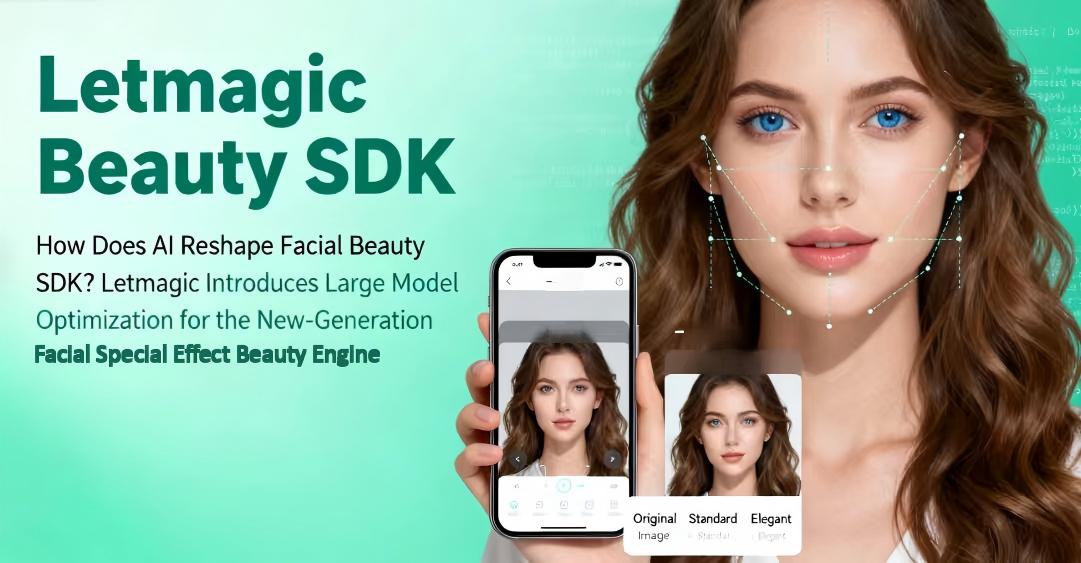
In the face beauty SDK industry, "naturalness" and "personalization" have always been the core goals pursued by developers.
Over the past few years, the industry has mostly relied on traditional algorithms for parameter optimization—for example, adjusting beauty effects through fixed facial key points.
However, bottlenecks are inevitable: when users wear makeup of varying intensity, the skin-smoothing effect either "blurs the makeup" or "fails to remove blemishes completely"; when users with different face shapes use the same set of face-shaping parameters, the result is either an unnaturally "sharpened face" or "no visible effect at all".
This "one-size-fits-all" dilemma was not resolved until the implementation of AI large model technology in the beauty field. As a team with years of experience in beauty technology, Letmagic Beauty SDK has recently integrated large models into the core engine of its beauty SDK, reconstructing the underlying logic of skin smoothing, face shaping, and special effect generation. This breakthrough also reveals AI’s potential to reshape beauty SDKs.
From the perspective of practical technology implementation, this article explores how large models address the pain points of traditional beauty solutions and details the optimization directions of Letmagic Beauty SDK’s new-generation engine.
I. Pain Points of Traditional Beauty SDKs: Why Do We Need AI Large Models to Break the Deadlock?
Before introducing large models, our team conducted an industry survey, collecting feedback from nearly 200 developers and 5,000 pieces of user experience data. The results showed that traditional beauty SDKs are mainly constrained by three key pain points:
1. Rigid Scene Adaptation
Traditional skin-smoothing algorithms rely on preset thresholds to identify blemishes—for instance, classifying pixels with brightness below a certain value as acne marks and processing them. However, when users wear dark lipstick or frame glasses, misjudgments occur: the algorithm either blurs the edges of the lipstick or treats eyeglass frames as blemishes.
A social app client once reported that when users enabled beauty mode in backlit environments, their faces appeared with "patchy bright and dark areas". This issue arose because traditional algorithms cannot dynamically recognize changes in lighting.
2. Lack of Personalization
Traditional face shaping relies on fixed templates. For example, "face thinning" simply reduces the overall range of the jawline. However, users with round faces need "jawline refinement", while those with square faces require "softening of angular jawbones". Using a single template often leaves users feeling that the result "doesn’t look like themselves".
The same limitation applies to filters: traditional filters adjust colors globally. If a user wants to retain their "lipstick color" while modifying "skin brightness", it is impossible—they can only choose between "full filter application" or "no filter at all".
3. Conflict Between Resource Loading and Performance
To meet diverse needs, traditional SDKs package a large number of preset resources, such as dozens of filters and hundreds of stickers. This causes the SDK size to often exceed 100MB, with an initial loading time of 5–8 seconds. Mid-to-low-end devices may even experience lag.
A live-streaming client calculated that slow SDK loading extended users’ waiting time before going live, directly reducing the live broadcast conversion rate by 8%.
The core of these pain points lies in the fact that traditional algorithms "only execute pre-set rules and cannot make active judgments". In contrast, AI large models excel at "understanding scenarios and adapting dynamically"—this is the key reason we decided to introduce large models for optimization.
II. Letmagic Beauty SDK’s Large Model Implementation Approach: From "Rule-Driven" to "Data-Driven"
Integrating large models is not simply replacing existing algorithms; it involves reconstructing the underlying logic of the beauty engine. Our team spent 6 months decomposing large model capabilities into three core modules—skin smoothing, face shaping, and special effect generation—with each module specifically addressing traditional pain points.
1. Skin Smoothing Module: Hierarchical Semantic Understanding to Solve Scene Adaptation Issues
Traditional algorithms use "global unified processing", while we now leverage large models for "hierarchical semantic understanding". Specifically, the large model first performs semantic segmentation on the input face image, dividing it into four layers: "skin blemish area", "makeup area", "hair area", and "accessory area". Each layer is processed with a tailored strategy.
For example, when the "makeup area" (lipstick, eyeshadow) is identified, the model retains its color and texture while only applying slight skin smoothing to the underlying skin tone. When the "hair area" (eyebrows, eyelashes) is detected, skin smoothing is skipped entirely to avoid "blurred eyebrows".
During testing, a comparison showed that for the same user with makeup, traditional skin smoothing increased the blurriness of lipstick edges by 30%, while large model-based smoothing controlled this blurriness to within 5%—all while maintaining an acne mark removal rate of over 90%.
More importantly, in terms of lighting adaptation, the large model can real-time identify ambient light types (backlight, side light, warm light) and automatically adjust skin smoothing intensity. For example, in backlit scenarios, it reduces smoothing intensity in high-light areas to prevent overexposure; in warm light scenarios, it slightly enhances skin transparency to avoid yellowish skin tones.
2. Face Shaping Module: Personalized Adaptation + Expression Adaptation to Eliminate "Unrealistic Face"
Traditional face shaping uses "fixed parameter adjustment", while large model-based face shaping achieves "personalized adaptation". We first trained the model on over 100,000 samples of different face shapes and skin types, enabling it to recognize users’ "facial features" (round, square, long faces) and "facial proportions" (eye spacing, nose length), then generate customized face-shaping solutions.
For instance, when a "round-faced user" is identified, the model focuses on adjusting the jawline curve while preserving the fullness of the cheekbones. For a "square-faced user", it slightly softens the angular jawline without altering the overall facial proportions.
Another practical feature is "expression adaptation". Traditional face shaping often causes "facial indentations" when users laugh or frown, as parameters are fixed and do not adjust with expressions.
In contrast, the large model real-time tracks dynamic changes in 256 facial key points. For example, when a user laughs, it automatically relaxes face-shaping parameters in the cheek area to avoid indentations; when a user frowns, it reduces the stretching intensity in the forehead area to prevent exaggerated forehead wrinkles. Test data shows that with large model face shaping, user feedback about "unrealistic faces" during dynamic expressions decreased by 65%.
3. Special Effect Generation Module: Real-Time Generation + Lightweight Design to Balance Resources and Performance
Traditional special effects require pre-packaged materials, but we now use large models for "real-time generation". For example, if a user wants a "cherry blossom filter", the model generates the filter effect in real time based on the current frame’s color and lighting—no pre-downloaded material package is needed. If a user wants "dynamic stickers" (e.g., cat ears), the model generates stickers that fit the face in real time based on the face’s position and angle, eliminating the need for preloaded sticker resources.
As a result, the core resource size of the SDK was reduced from 80MB to 20MB, and the initial loading time was shortened from 5 seconds to under 1.5 seconds. We also implemented "lightweight optimization": the large model’s inference process is completed on the device side (edge computing), without calling cloud interfaces—this avoids network latency while controlling CPU and GPU usage. On Snapdragon 7-series devices, enabling large model-based beauty effects + special effects maintains a stable frame rate of over 50fps, a 15% improvement compared to traditional solutions.
III. Practical Value of the New-Generation Engine: Benefits for Both Developers and Users
Large model optimization is not just "technical showmanship"; its ultimate goal is to be applied in real business scenarios and solve developers’ practical problems. Feedback from current cooperative clients shows that the new-generation engine delivers value in three key aspects:
1. For Developers: Significantly Improved Integration Efficiency
We encapsulated the core capabilities of the large model into simple API interfaces. Developers do not need to understand large model principles—they only need to call two interfaces, "enableAIMakeup" and "setAIShapeStyle", to activate large model-based beauty and face-shaping functions.
A short-video app client reported that integrating traditional beauty features took 3 days, while integrating large model-based beauty took only 1 day—with no additional compatibility issues. This is because the model has already been adapted to mainstream devices running Android 8.0+, iOS 12.0+, and even HarmonyOS.
2. For Operation Teams: Enabling Personalized Recommendations
The large model can real-time analyze user usage habits. For example, if a user frequently adjusts "whitening +20%" and "face thinning +10%", the model automatically generates a "user preference template". Next time the user enables beauty mode, this template is loaded by default. It can also recommend special effects based on scenarios: for example, if a user is live-streaming outdoors, it recommends a "backlight optimization filter"; if a user is taking selfies indoors, it suggests a combination of "natural skin smoothing + lightweight face shaping".
A live-streaming client feedback that after adopting personalized recommendations, the usage rate of beauty features increased by 22%.
3. For Users: Noticeable Experience Upgrades
We collected nearly 1,000 pieces of user feedback: 90% of users stated that "the beautified result looks more like themselves", and 85% felt that "no strange distortions occur during dynamic expressions".
A small but important improvement: previously, users who wore glasses often encountered "increased glare on lenses" when enabling beauty mode. The large model now automatically identifies the glasses area and reduces brightness adjustment intensity there—such complaints have almost disappeared.
IV. Future Directions of AI-Reshaped Beauty SDKs
Integrating large models is just the beginning. From an industry perspective, AI’s reshaping of beauty SDKs will deepen in three directions:
1. Cross-Scenario Adaptation
For example, when a user moves from indoors to outdoors (with sudden changes in lighting and background), future large models will real-time recognize scenario switches and automatically adjust beauty, filter, and special effect parameters—no manual adjustment by the user is needed.
Our team is already developing a "scene semantic understanding" function. For instance, when a "food live-streaming" scenario is identified, it enhances skin transparency while preserving the color saturation of food. When a "sports scenario" is detected, it reduces face-shaping intensity to avoid facial distortion during movement.
2. Multimodal Fusion
Current beauty functions rely solely on image data. In the future, they will integrate voice and motion data: for example, when a user speaks, the model recommends filter styles based on their tone (cheerful, gentle); when a user makes a gesture (e.g., a heart shape), it automatically triggers corresponding dynamic stickers. This multimodal fusion will transform beauty effects from "static enhancements" to "dynamic interactions".
3. Private Deployment
Many enterprise clients are concerned about data security. In the future, large models will support private deployment—allowing models to be deployed on clients’ own servers or edge devices. This eliminates the need to upload user image data to the cloud, ensuring data security while reducing network dependence.
For developers, when choosing an AI beauty SDK, there is no need to blindly pursue the "large model" label. The key is whether it can solve practical pain points—such as skin smoothing with makeup, dynamic face shaping, and lightweight design.
The essence of Letmagic Beauty SDK’s new-generation engine is using large model technology to transform "complex technology" into "simple experiences". This allows developers to deliver high-quality beauty effects to users without investing extensive resources in technical research and development.
In the future, as large model technology matures, beauty SDKs will become increasingly "user-aware". Instead of "applying one set of parameters to all", they will deliver "personalized experiences tailored to each user". For us, the core goal remains: continuously using technology to solve industry pain points, helping developers avoid pitfalls, and providing users with better experiences.